
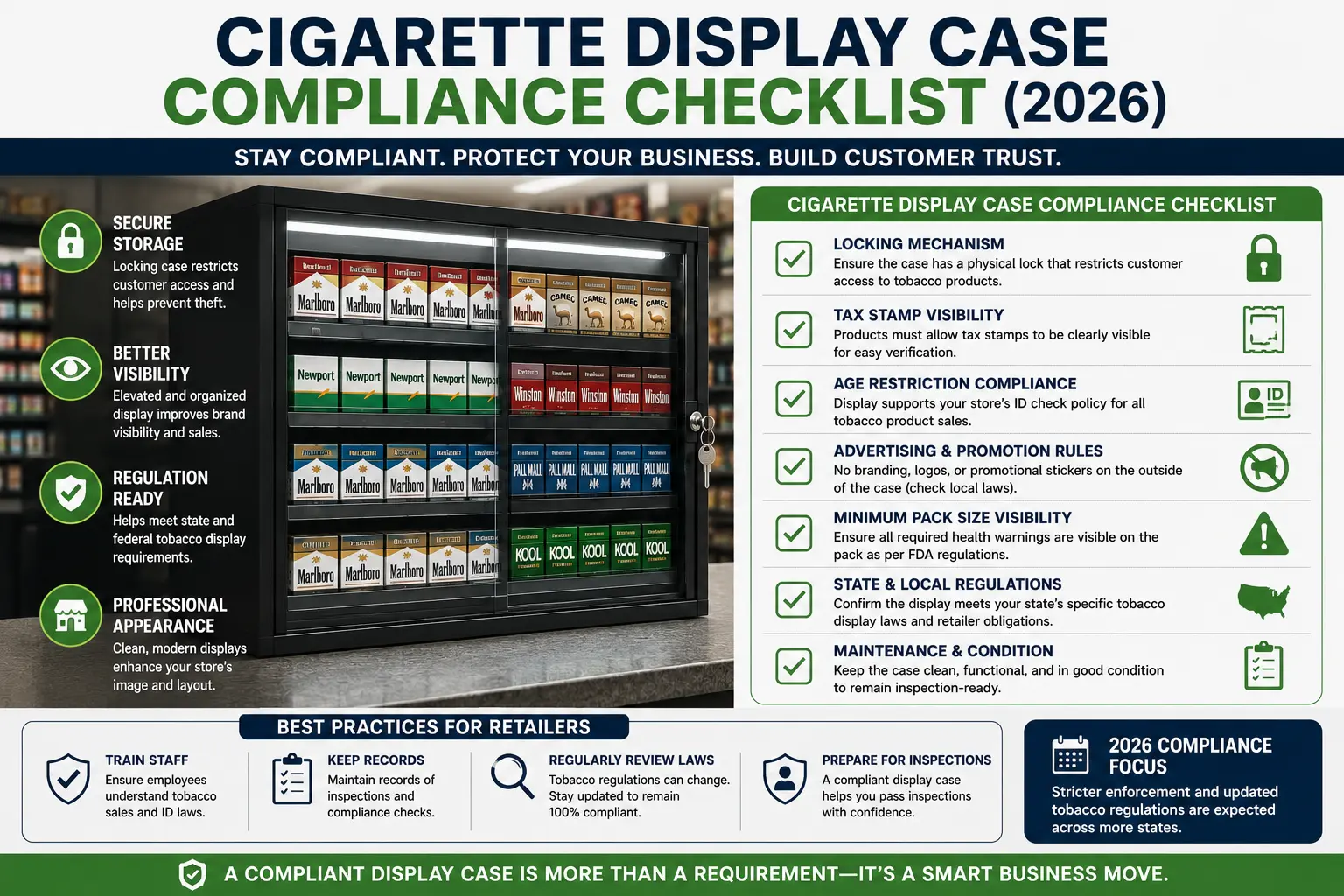
Getting your cigarette display case placement wrong is not just a merchandising mistake, it is a compliance risk that can lead to fines or a suspended tobacco license. Federal rules under the Family Smoking Prevention and Tobacco Control Act, plus the PACT Act and your state’s own tobacco statutes, all shape where and how tobacco can be displayed. This checklist walks through the areas retailers get checked on most often, so you can review your current setup before an inspection finds the gap for you.
This article is written for general planning purposes and is not legal advice. Tobacco and vape regulations vary by state and change often, so confirm current requirements with your state’s tobacco licensing authority or legal counsel before finalizing your store layout.
Why Cigarette Display Case Compliance Matters
Tobacco is one of the most heavily regulated product categories a retailer can carry. Inspectors from state alcohol and tobacco agencies, along with FDA-contracted compliance checks, routinely test whether stores are selling to minors and whether product is displayed in a way that invites self-service. A well-planned cigarette display case setup, built around a compliant custom cigarette rack sized to your counter, reduces both the compliance risk and the shrink that comes from unsupervised access.
Self-Service Display Rules
The 2009 Family Smoking Prevention and Tobacco Control Act bans self-service displays for cigarettes and smokeless tobacco in nearly all retail settings. In practice, that means a cigarette display case cannot sit on an open sales floor where a customer can reach in and grab a pack without a clerk handling the transaction. The accepted exception is adult-only facilities that can reliably verify no one under 21 is present, which covers very few general retail environments.
For most convenience stores, gas stations, and smoke shops, that means the display belongs behind the counter or in another cashier-controlled area, using a case such as the 9 x 8 Cigarette Rack or a compact 4′ x 7′ Cigarette Rack positioned where only staff can physically access it.
Age Verification at the Point of Sale
Every tobacco sale requires ID verification for anyone who appears under a set age, commonly 27 to 30 depending on store policy, even though the legal purchase age is 21 in nearly every state. The defensible standard going into 2026 is a point-of-sale system that logs each age-restricted transaction: whether ID was checked, what type of ID was used, and which cashier processed the sale. This log matters as much during an inspection as the physical placement of your cigarette display case.
Vending Machines and Impersonal Sales
Tobacco vending machines are prohibited in any location minors are permitted to enter. If your store allows anyone under 21 on the premises, which almost all convenience and grocery formats do, a vending machine is not a compliant way to sell cigarettes. This rule reinforces the same principle behind self-service bans: a staff member must be involved in verifying age before the sale completes.
PACT Act Requirements for Vape and E-Cigarettes
The Prevent All Cigarette Trafficking Act, expanded in 2020 to cover electronic nicotine delivery systems, requires retailers shipping tobacco or vape products to register with the ATF and applicable state tax agencies, collect and remit state excise taxes, and verify the age and identity of the recipient for any remote sale. If your store also displays vape products in a locked wall display case or counter fixture, apply the same self-service and age-verification standards you use for cigarettes.
Signage and Warning Requirements
Most states require a posted sign near the point of sale stating the minimum legal age to purchase tobacco, and federal rules require specific warning language on cigarette advertising and packaging. If you use an LED sign fixture for tobacco or vape branding, keep any required warning language legible and unobstructed. Check your state health department’s requirements for exact wording, since some states mandate specific font sizes or placement near the register.
2026 Compliance Checklist
| Area | Requirement | Status Check |
| Display location | Behind counter or cashier-controlled area only | No customer-reachable open display |
| Age verification | ID check for all customers appearing under set age | POS logs ID type and cashier ID |
| Vending machines | Prohibited where minors are permitted | None on premises unless adult-only venue |
| PACT Act registration | Required for remote or online tobacco sales | ATF and state registration current |
| Signage | Minimum purchase age posted at point of sale | Sign visible and current wording |
| Staff training | Employees trained on ID checks and refusal | Documented training on file |
Compliance Checklist for Your Cigarette Display Case
- Confirm the cigarette display case sits behind the counter, not on the open sales floor
- Verify no self-service access is possible from the customer side of the register
- Post current minimum-age signage within view of the point of sale
- Confirm your POS system logs ID checks for every age-restricted transaction
- Check your state’s tobacco retailer license is current and displayed if required
- Review PACT Act registration status if you ship or sell tobacco products remotely
- Train new staff on ID verification before they run tobacco transactions unsupervised
Frequently Asked Questions
Can cigarettes be displayed on an open shelf customers can reach?
No. Federal rules under the Tobacco Control Act ban self-service cigarette displays in nearly all retail settings, so the display case must sit in a cashier-controlled area.
What age must I verify ID for before selling tobacco?
The legal purchase age is 21 in nearly every state. Many retailers set an internal policy to check ID for anyone who appears under 27 to 30 to stay well within compliance.
Does the PACT Act apply to vape products?
Yes. The PACT Act was expanded in 2020 to cover electronic nicotine delivery systems, including vapes, e-cigarettes, and e-liquids sold or shipped across state lines.
Are tobacco vending machines legal?
Only in locations that can verify no one under 21 is present, which excludes almost all general convenience and grocery retail formats.
What signage is required near a cigarette display case?
Most states require a posted sign stating the minimum legal purchase age near the point of sale, though exact wording requirements vary by state.
How often do tobacco compliance rules change?
State and federal tobacco rules are updated periodically, so it is worth checking your state’s tobacco licensing authority at least once a year or whenever you change your display layout.
Conclusion
A compliant cigarette display case setup comes down to three habits: keep the display in a cashier-controlled area, verify ID on every age-restricted sale, and keep your signage and licensing current. Building those habits into your daily routine protects your tobacco license and reduces shrink at the same time.
Kwality Fixtures builds cigarette racks designed for secure, behind-counter placement. Request a quote to fit your compliant layout.