
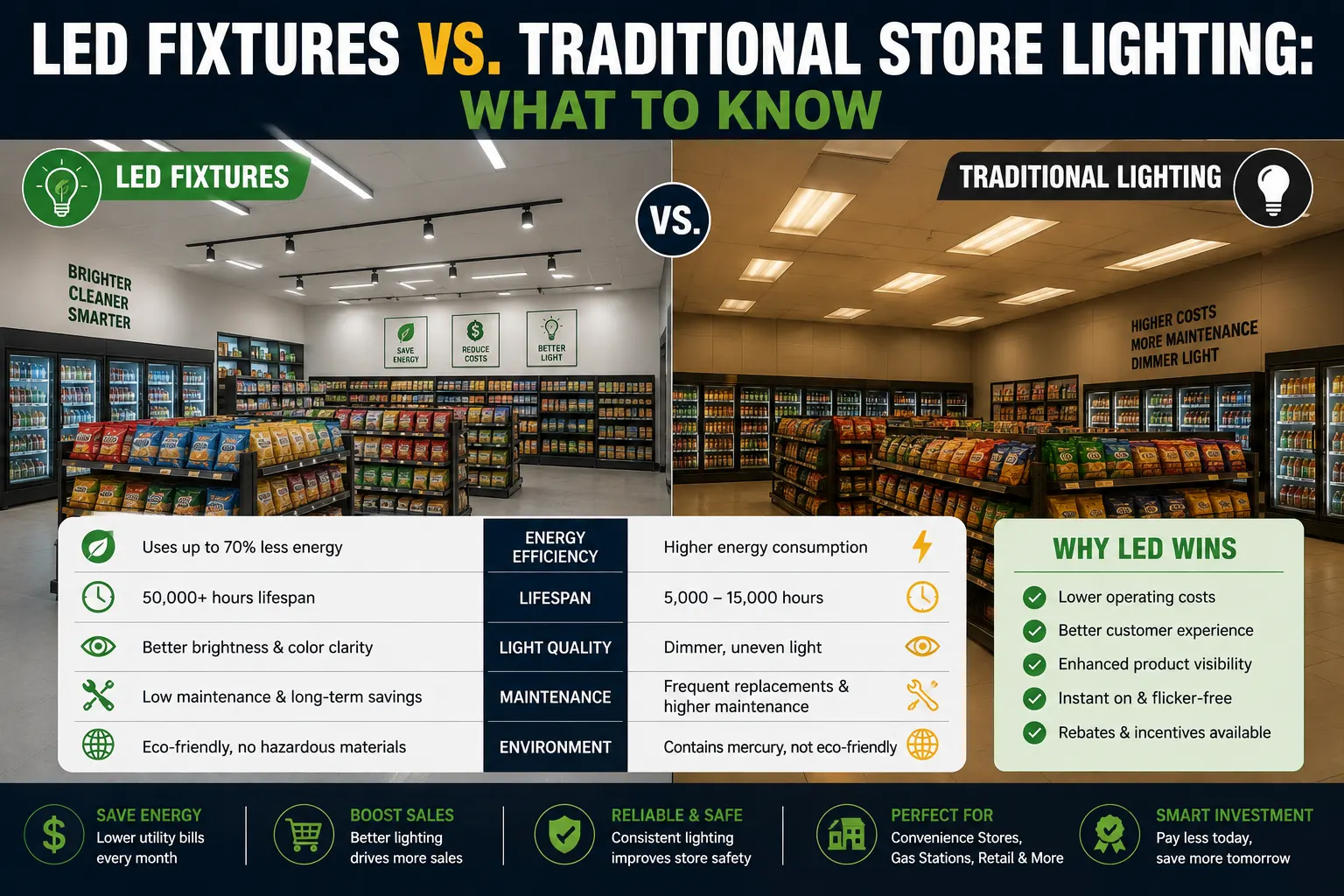
If your store is still running on fluorescent tubes or metal halide bulbs, you have probably wondered whether switching to LED fixtures is worth the upfront cost. The short answer is that for nearly every retail application, LED now outperforms older lighting technology on energy use, lifespan, and light quality. Here is what actually changes when you make the switch.
The Three Traditional Lighting Types
Most stores still running older lighting use one of three technologies: fluorescent tubes for interior ceiling grids, metal halide for high-bay or parking lot fixtures, and occasionally incandescent or halogen for accent lighting. Each has a direct LED replacement designed for the same mounting type, whether that is a flat LED Panel Light 2×4 for a drop-ceiling grid or a High Bay Light 240W for a tall warehouse-style ceiling.
Energy Use Compared
LED fixtures typically use 50 to 75 percent less electricity than the fluorescent or metal halide fixture producing the same brightness. That difference compounds for stores running lights 12 or more hours a day, since the wattage saved on every fixture adds up across an entire ceiling grid or parking lot. Older HID fixtures like metal halide also draw a large surge of power when starting up, which LED fixtures do not require.
Lifespan and Maintenance
Fluorescent tubes typically last 10,000 to 20,000 hours before needing replacement, and metal halide bulbs often fall in a similar range or lower, especially with frequent on-off cycling. LED fixtures are commonly rated for 50,000 hours or more, which can mean years between replacements instead of an ongoing cycle of bulb changes, ballast failures, and ladder time for maintenance staff.
Light Quality and Color Accuracy
LED fixtures generally offer better and more consistent CRI than older fluorescent tubes, which means merchandise colors read more accurately under LED light. LED output also stays steady over its lifespan, while fluorescent tubes noticeably dim and shift color as they age. For any store where color accuracy affects buying decisions, from clothing to fresh food, this is one of the more noticeable differences customers pick up on even without knowing why. Many retailers pair LED panel and canopy fixtures with a branded LED sign fixture out front, since consistent light quality inside and clear signage outside work together to draw foot traffic.
Heat Output and Warm-Up Time
Metal halide fixtures need several minutes to reach full brightness after being switched on, and even longer to restrike if they are turned off and back on too soon. LED fixtures reach full brightness instantly, which matters for stores with irregular hours or fixtures on motion sensors. LED fixtures also run cooler than fluorescent or metal halide, which reduces the load on your HVAC system during warmer months.
Side-by-Side Comparison
| Factor | Fluorescent / Metal Halide | LED Fixtures |
| Typical lifespan | 10,000 – 20,000 hours | 50,000+ hours |
| Energy use | Baseline | 50-75% lower for equal brightness |
| Warm-up time | Metal halide: minutes to full brightness | Instant full brightness |
| Color consistency over time | Dims and shifts color as tubes age | Stays consistent through most of its life |
| Heat output | Higher, adds HVAC load | Lower, reduced HVAC load |
| Mercury content | Fluorescent tubes contain mercury | No mercury |
When a Retrofit Makes Sense
A full retrofit makes the most sense when your existing fixtures are approaching end of life anyway, since you avoid paying twice for the same ceiling grid. It is also worth prioritizing high-usage areas first, such as the main sales floor and any fixture running 12 or more hours a day, since those locations see the fastest return in energy savings. Outdoor metal halide pole and canopy lights are typically the next priority, both for energy savings and for eliminating the restrike delay after a power flicker. A Pole Light 300W or Wall Pack LED Light 120W covers most parking lot and entrance retrofits, while a well-lit sales floor also pairs naturally with illuminated fixtures like an LED glass wall showcase, which brings the same lighting upgrade down to the display level.
Frequently Asked Questions
How much less energy do LED fixtures use compared to fluorescent?
LED fixtures typically use 50 to 75 percent less energy than fluorescent or metal halide fixtures producing similar brightness.
Do LED fixtures need warm-up time like metal halide?
No. LED fixtures reach full brightness instantly, while metal halide fixtures can take several minutes to warm up and even longer to restrike after being turned off.
Do fluorescent tubes contain mercury?
Yes, fluorescent tubes contain a small amount of mercury and require special disposal, while LED fixtures do not contain mercury.
How long do LED fixtures last compared to fluorescent tubes?
LED fixtures are commonly rated for 50,000 hours or more, compared to roughly 10,000 to 20,000 hours for fluorescent tubes.
Should I replace all my store’s lighting at once or in stages?
Many retailers prioritize high-usage areas like the main sales floor first, then move to outdoor metal halide fixtures, spreading the retrofit across stages rather than all at once.
Conclusion
Between lower energy use, a much longer lifespan, and steadier color quality, LED fixtures outperform fluorescent and metal halide lighting in nearly every retail application. The only real question left is timing: retrofitting when existing fixtures near end of life, starting with your highest-usage areas, gets you the fastest return without paying to replace lighting twice.
Ready to compare options for your store? Browse LED fixtures from Kwality Fixtures or request a quote for your retrofit.