
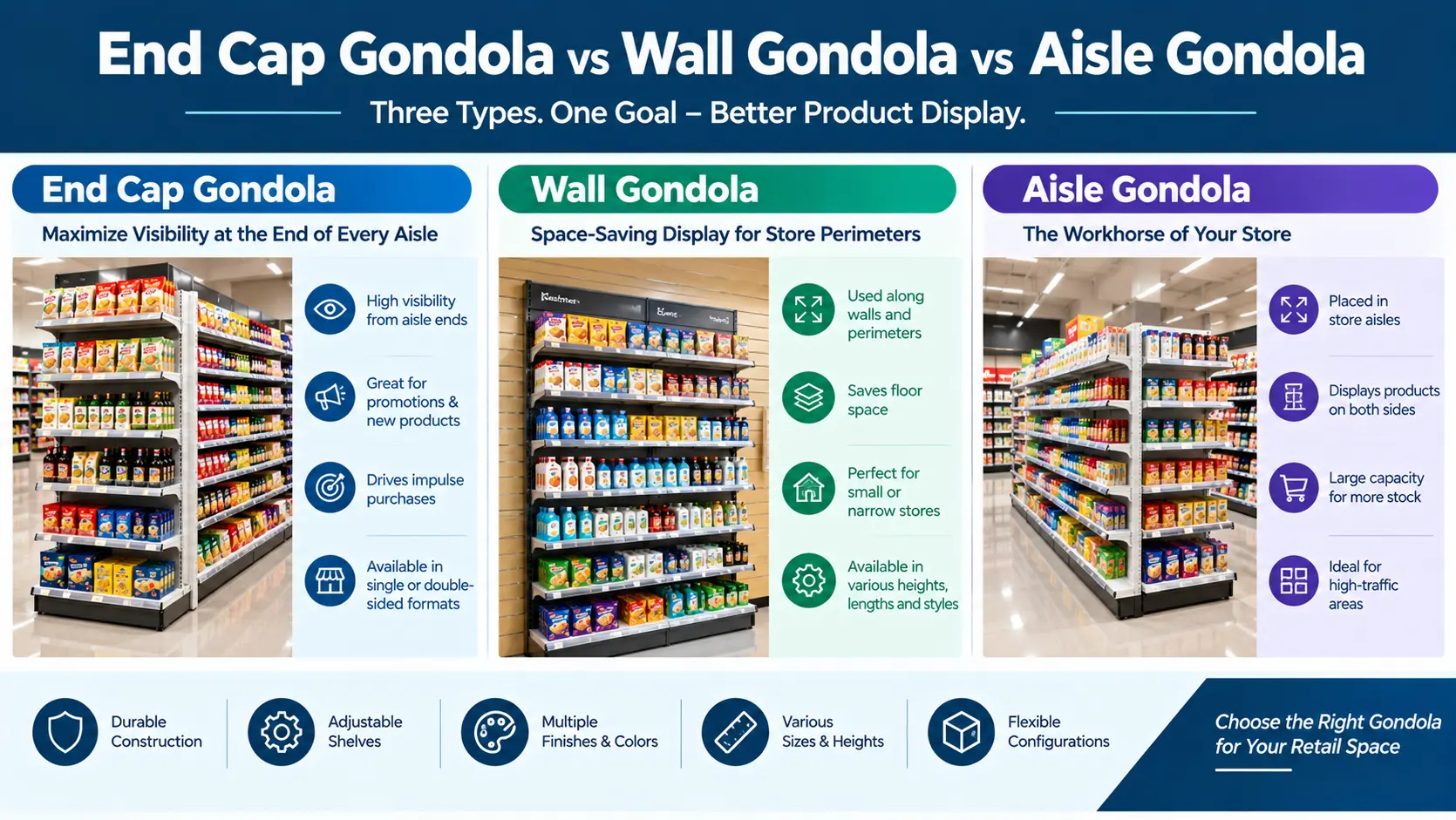
Most stores use three kinds of gondola, and each one does a different job. Wall gondola holds the bulk of your range along the perimeter. Aisle gondola creates the walkways in the middle of the floor. The end cap gondola sits at the head of each aisle, facing the main traffic path, and sells whatever you put on it faster than almost any other shelf in the building.
Choosing the right mix is a layout decision, not a catalog decision. This guide compares the three side by side so you can decide where each belongs, how many you need, and how to size them for the products you sell. All three are part of our gondola shelving range and share the same widths, heights and accessories.
What Is an End Cap Gondola?
An end cap gondola is a short gondola section mounted across the end of a double-sided aisle. Instead of facing into the aisle, its shelves face the main walkway, the checkout or the entrance. Shoppers see it before they decide whether to turn into the aisle.
That position is why retailers use the end cap gondola for:
- New products and launches
- Promotions, multi-buy offers and price drops
- Seasonal goods (summer drinks, holiday candy, back-to-school items)
- High-margin impulse items near the register
- Overstock that needs to move quickly
Our gondola end cap is built in 3 ft and 4 ft widths and the same heights as our aisle units (48 to 96 inches), so it matches the run it closes.
End Cap vs “Endcap”
You will see both spellings. They mean the same fixture. Some suppliers also call it an end cap unit or an end gondola. Whatever the name, the end cap gondola is defined by where it stands: perpendicular to the aisle, facing traffic.
Wall Gondola: Single-Sided Perimeter Shelving
Wall gondola is single-sided. It has a back panel and shelves on one face, and it stands against the store walls. It usually forms the longest continuous runs in the store and carries the core range: groceries, household goods, auto care, health and beauty.
Key traits of wall gondola:
- Taller heights are common (72 to 96 inches), since nobody needs to see over a wall.
- Deeper base decks handle heavy and bulky products at floor level.
- Long runs of one starter plus several add-ons keep cost per foot down.
- Finished ends tidy up the end of each run where it meets a door or cooler.
Our gondola wall starter measures 48 inches wide by 22.5 inches deep by 84 inches high, with metal pegboard backs (1/4 inch holes, 1 inch on center) and finished ends on both sides. Add-on sections extend the run in the same height.
Aisle Gondola: Double-Sided Island Runs
Aisle gondola is double-sided. It stands in the middle of the floor with shelves on both faces, creating two shopping walls from one fixture. Rows of aisle gondola form the aisles shoppers walk through.
Key traits of aisle gondola:
- Lower heights (48 to 60 inches) are typical in convenience stores, so staff at the counter can see across the floor.
- Two bases and two shelf sets per section, one for each face.
- Runs need ends. Each run has two open ends, which is where the end cap gondola goes.
Our aisle gondola is available in black, white and wood grain finishes to suit different store styles.
Side-by-Side Comparison
Here is how the three types compare on the factors that matter most when planning a store.
Position and Footprint
- Wall gondola: against walls; uses perimeter space that would otherwise be empty.
- Aisle gondola: center floor; needs clear walkways on both sides.
- End cap gondola: at aisle ends; adds depth to the run but faces the main walkway.
Sightlines and Security
- Wall gondola: height is rarely a problem; tall units are fine.
- Aisle gondola: height affects how much of the floor staff can see. Keep it low in small stores.
- End cap gondola: sits in the most visible part of the floor, so it is naturally easy to watch.
Best Products
- Wall gondola: core range, heavy and bulky items, everyday essentials.
- Aisle gondola: grouped categories (snacks in one aisle, household in another).
- End cap gondola: promotions, seasonal goods, new launches, high-margin impulse buys.
Change Frequency
- Wall gondola: stable; planograms change a few times a year.
- Aisle gondola: moderate; categories shift with seasons.
- End cap gondola: high; many stores reset end caps every few weeks.
Capacity per Foot
- Wall gondola: high, especially on tall units with deep bases.
- Aisle gondola: high, because it holds product on both faces.
- End cap gondola: lower, since it is only one section wide, but each foot sells harder.
How Many End Caps Does a Store Need?
The math is simple: every double-sided aisle run has two ends, so each run can carry two end cap gondola units. A store with three center runs can have up to six end caps.
Not every end needs one. Skip an end cap gondola where:
- The aisle end faces a wall or cooler door with no traffic.
- The end sits in a fire exit route or blocks a clear path.
- You do not have enough promotional stock to keep it full.
An empty or half-stocked end cap looks worse than a plain aisle end. Plan only as many as you can keep full and fresh.
End Caps in Small Stores
In a small convenience store, aisle runs are short, so end caps make up a large share of the selling space. Two short runs with four end caps can give you four promotional zones in a store with only a few hundred square feet of center floor. That is a strong reason to include an end cap gondola on every run that faces customer traffic.
Sizing an End Cap Gondola
An end cap gondola should match the run it closes, but there are a few choices to make.
Width
Match the end cap width to the total depth of the double-sided run. A run with two shallow bases may suit a 3 ft end cap; deeper runs often use 4 ft. Our end caps come in both widths.
Height
Keep the end cap gondola at the same height as the aisle, or slightly lower. A taller end cap can block the view down the aisle and hide the shelf behind it.
Shelves
End cap shelves are sized to the end cap width, not the aisle width. A 36 inch gondola shelf for end cap units fits a 3 ft end cap. Plan for fewer, deeper shelves if you stack promotional cases, or more, shallower shelves if you display many single items.
Accessories
Fencing on end cap shelves keeps stacked stock from sliding. Hooks on the pegboard back work well for bagged snacks and carded items. Price labels should be large and clear, since most end cap products are on offer.
Mixing All Three in a Real Layout
A typical convenience store layout might look like this:
- Wall gondola along the two longest walls, 72 inches high, for grocery, household and auto care.
- Two or three aisle gondola runs in the center, 54 inches high, for snacks, candy and personal care.
- An end cap gondola at each run end that faces the entrance or the checkout.
- Behind-the-counter fixtures such as cigarette racks for tobacco, which should not sit on open gondola.
- Locked glass cases for high-value items like vape products, phone accessories or collectibles, which you can see in our wall display cases range.
Grocery stores follow the same pattern at a larger scale, with taller aisle units and longer runs. Pharmacies often add more hooks and fewer deep shelves. The principle stays the same: wall gondola for range, aisle gondola for categories, end cap gondola for promotion.
Planning Traffic Flow Around Aisles and End Caps
Gondola type and traffic flow have to be planned together. A fixture in the wrong spot can block a path, hide a product, or create a corner nobody visits.
Aisle Width
Leave enough room between aisle runs for two shoppers to pass, for a cart or stocking trolley, and for customers using mobility aids. Check local building and accessibility requirements before fixing your layout. Wider aisles mean fewer runs, so decide aisle width before you count units.
The Main Walkway
The main walkway usually runs from the entrance past the ends of the aisles toward the checkout or the back coolers. That walkway is where the end cap gondola earns its place. Shoppers on it see every end cap in sequence, which is why promotions there perform so well.
Back-of-Store Draw
Put destination items (coolers, dairy, bread) at the back or along the far wall so customers walk past the wall gondola and the end caps on the way. A clear route from the entrance to those destinations, lined with end caps, turns a quick visit into a bigger basket.
Checkout Zone
The space around the register is the highest-value floor in a convenience store. A low aisle run or a single end cap gondola near the counter can hold candy, gum, chargers and other impulse items, while tobacco stays behind the counter on dedicated racks.
Choosing Heights by Store Size
Height affects capacity, sightlines and how open the store feels. Here is a practical starting point:
- Small convenience stores (under 2,000 sq ft): wall gondola at 72 inches, aisle gondola at 48 to 54 inches, end caps matching the aisles.
- Mid-size markets and pharmacies: wall gondola at 72 to 84 inches, aisle gondola at 54 to 60 inches.
- Grocery and large format: wall gondola at 84 to 96 inches, aisle gondola at 60 to 72 inches, with taller end caps where they do not block views.
Our wall, aisle and end cap units share the same height options (48, 54, 60, 72, 84 and 96 inches), so it is easy to keep an end cap gondola level with the run it closes.
Finish and Store Style
All three gondola types should look like one family. A mismatched end cap gondola draws attention for the wrong reason. Common finishes include:
- Black: modern, hides scuffs, suits convenience stores and smoke shops.
- White: bright and clean, suits pharmacies and health stores.
- Baize (beige): neutral, suits grocery and general merchandise.
- Wood grain: warmer look for specialty shops and boutique grocers.
If you plan to add sections over time, choose a finish you can reorder easily so new units match the old ones.
Merchandising Tips for End Caps
A well-run end cap gondola can outsell several aisle sections. These habits help:
- One message per end cap. A single brand, theme or offer reads better than a mix.
- Put the hero product at eye level. Supporting items go above and below.
- Change it on a schedule. A fixed reset cycle (every two to four weeks) keeps regulars noticing.
- Tie it to the aisle. Put an end cap product’s companion items in the aisle behind it.
- Keep it full. Assign staff to restock end caps first.
- Price clearly. Most end cap shoppers are scanning for a deal.
Resetting an End Cap: A Simple Routine
Because end caps change often, a repeatable reset routine saves time and keeps every display looking intentional:
- Pick the theme a week ahead and confirm stock levels with your supplier.
- Clear the end cap fully, including hooks and fencing that will not be reused.
- Wipe shelves and check brackets for bends or loose clips.
- Set shelf heights for the new products before you load anything.
- Load from the bottom up, heaviest items lowest, hero product at eye level.
- Add signage and price labels that match the offer.
- Photograph the finished display so the next reset or another store can copy it.
Stores with several locations often share these photos as simple planograms, so every end cap gondola in the chain carries the same promotion in the same way.
Common Mistakes When Choosing Gondola Types
- Using tall aisle units in a small store. It creates blind spots at the counter.
- Buying end caps for every run by default. Some ends face nothing and stay empty.
- Ignoring finish. A black end cap on a white aisle looks like an afterthought. Order matching finishes.
- Forgetting the end cap shelves. End caps use different shelf widths than aisles.
- Putting promotions deep in an aisle. Offers belong on the end cap gondola where traffic sees them.
Starter and Add-On Units in Each Type
Whichever type you choose, runs are built the same way. A starter section stands on its own with uprights at both ends. Add-on sections attach to it and share an upright, which makes long runs efficient. Wall runs and aisle runs both use this system. The end cap gondola attaches to the end of the aisle run and faces outward.
If you are expanding an existing layout, match width, height and pegboard pattern so new sections and end caps line up with what is already on the floor.
Plan Your Mix With Kwality Fixtures
Not sure whether a wall run, an extra aisle or another end cap gondola will help your store most? Send us your floor plan and product list and we will suggest a layout and a configuration for each section.
Visit our showroom at 1841 Mountain Industrial Blvd, Tucker, GA 30084, call +1 404-388-0786 or +1 470-640-1404, or reach us through our contact page. We offer installation and support, and we ship across all US ZIP codes.
FAQ
What is the difference between an end cap gondola and an aisle gondola?
An aisle gondola is double-sided and forms the length of an aisle. An end cap gondola is a single section placed across the end of that aisle, facing the main walkway, and is used mainly for promotions.
Can an end cap gondola be used on its own?
It is designed to close an aisle run, but a single end cap section can stand against a column or a short wall as a feature display if it is stable and level.
How tall should an end cap gondola be?
Usually the same height as the aisle it closes, or slightly lower so it does not block the view into the aisle.
Is wall gondola the same as aisle gondola?
No. Wall gondola is single-sided and stands against a wall. Aisle gondola is double-sided and stands in the center of the floor.
Do end caps use the same shelves as the aisle?
No. End cap shelves match the width of the end cap (for example, 36 inches for a 3 ft end cap), not the length of the aisle sections.
Which gondola type should I buy first?
Most new stores start with wall gondola, because it holds the core range. Aisle runs come next, and an end cap gondola is added to each run that faces customer traffic.
How often should end caps be changed?
Many stores reset end caps every two to four weeks, or whenever a promotion ends. Regular changes keep returning customers noticing what is new.
Can I add end caps to an existing aisle?
Yes, as long as the end cap matches the height, finish and pegboard pattern of your run. Call +1 404-388-0786 and we will help you check.