
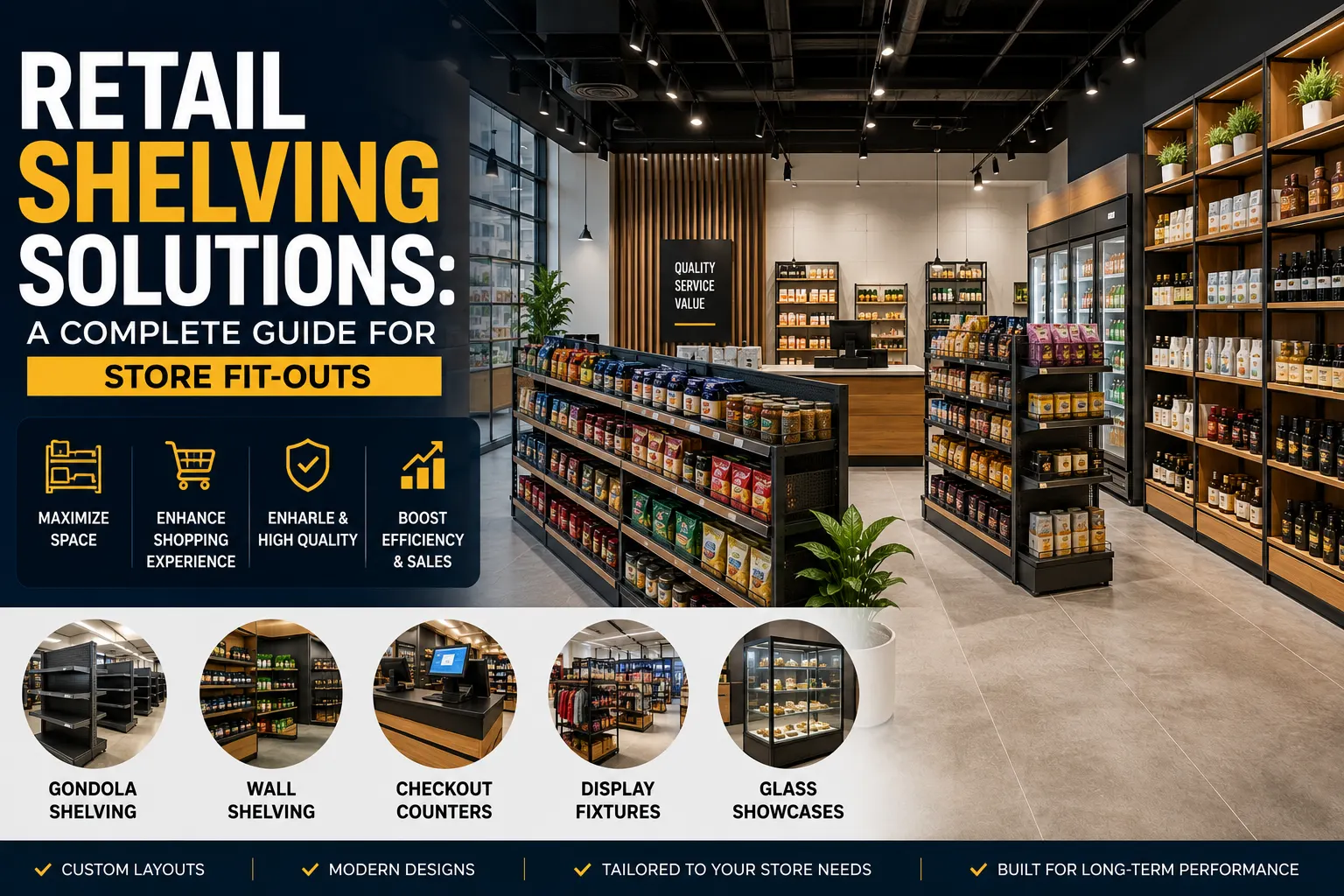
Retail shelving solutions are the backbone of any store fit-out, and picking the wrong ones is an expensive mistake to fix later. Whether you’re opening a smoke shop, a boutique, or a full grocery aisle, the shelving you choose determines how much product you can display, how customers move through your space, and how the store actually looks once the doors open. Retail display fixtures do double duty: they hold inventory and they shape how customers experience the store, so the decision is worth more thought than picking whatever fits the floor plan. This guide breaks down what counts as a real shelving solution, how to choose by store type, how the common materials compare, and how to plan a layout that works with foot traffic instead of against it. Browse everything Kwality Fixtures offers as you plan your fit-out.
Retail Shelving Solutions: What They Actually Include
A retail shelving solution is more than a single rack. It’s the combination of structural fixtures, like gondola runs or wall-mounted units, plus the shelves, brackets, and accessories that turn empty wall or floor space into organized, sellable display area. Real retail shelving solutions account for the store’s layout, product mix, and traffic flow together, not just how many linear feet of shelving fit in the room. That’s the difference between a store that feels organized and one that feels like a warehouse with price tags.
Most full store fit-outs combine several types of retail store fixtures rather than relying on one system throughout. A convenience store might run gondola aisles down the middle and wall shelving around the perimeter, while a boutique might lean entirely on wood and glass for a more curated feel.
Choosing Shelving by Store Type
The right shelving system depends heavily on what you’re selling and how customers shop for it.
Convenience and Smoke Shops
These stores need dense, efficient storage that maximizes SKU count in a small footprint. Gondola shelving and wire shelving both work well here, since they hold a lot of product per linear foot and stand up to constant restocking. Cigarette racks, cooler space, and countertop displays round out the rest of the layout, and most of these stores lean on modular fixtures so the mix can shift as new product categories come in.
Boutique and Fashion Stores
Boutique retail leans toward wood and glass shelving because the fixtures themselves become part of the store’s visual identity. Fewer items are displayed per shelf, with more breathing room around each product, which is the opposite instinct from a high-density convenience layout but works better for premium positioning. Slatwall and gridwall systems paired with wood shelf inserts are especially common here, since they let a store change up its display racks for retail seasonally without rebuilding the walls.
Grocery and Supermarket Stores
Grocery relies almost entirely on gondola shelving for center-store aisles, supplemented with wall gondola runs and end caps for promotional displays. Volume and restocking speed matter more here than aesthetics, so heavy-duty steel construction is worth prioritizing over lighter-duty alternatives. End caps in particular carry outsized importance in grocery, since they capture impulse purchases from shoppers moving between aisles.
Shelving Materials Compared
Material choice affects cost, durability, and how the finished display racks for retail actually look on the floor.
Wire Shelving
Wire shelving is common for candy shelves, video and media displays, and slant-front merchandising where visibility matters more than concealment. It’s lightweight, inexpensive, and easy to reconfigure as a modular shelving system, which makes it a good fit for stores that rearrange product mix often. Browse the full wire shelving collection.
Wood Shelving
Wood melamine shelving is built to mount on slatwall or gridwall fixtures and comes in finishes like maple, walnut, black, and white, giving boutiques and specialty shops a warmer look than metal alternatives. Explore the wood shelving collection for sizing and finish options.
| PRODUCT SPOTLIGHT 12×48 Maple Wood Melamine Shelf A wood melamine shelf built to mount on slatwall or gridwall fixtures, sized for boutique and specialty retail displays. Key Specs • Measurements: 12″L x 48″W x 3/4″ thick • Material: melamine wood, maple finish • Mounts with any 12″ shelf bracket (brackets sold separately) Price: $12.50 Shop the Maple Wood Melamine Shelf » |
Glass Shelving
Tempered glass shelving, typically 3/16 inch thick, is the standard for jewelry cases, electronics, and any product where visibility from every angle matters. It reads as premium and clean, which is why it shows up so often in display cases rather than open-floor shelving. See the full glass shelving collection for available sizes.
Gondola and Metal Shelving
Gondola shelving is the workhorse of center-store retail: double-sided units for aisles, single-sided runs for walls, and end caps for promotional space. Configurations like the Beige Double-Sided Gondola Shelving Unit are built to requirement, with width, height, and shelf depth all selected to match your aisle plan, and priced with a custom quote once those specs are set. Browse the full gondola collection to see base units, end caps, and accessories.
Planning a Shelving Layout for Foot Traffic
Layout matters as much as the fixtures themselves. A few principles carry across almost every store type: keep a clear sightline from the entrance to the back of the store so customers can orient themselves immediately, place high-margin or high-interest items at eye level where they get noticed without extra effort, and leave aisles wide enough that two carts or shoppers can pass without a bottleneck at the busiest hours.
Many retailers plan this out with a simple planogram before ordering fixtures, mapping which product categories sit where and how that supports the store’s natural retail merchandising flow from entrance to checkout. It’s a lot cheaper to move boxes around on paper than to move a bolted-down gondola run after opening day.
It also helps to walk the space the way a first-time customer would, rather than the way staff move through it during a restock. Staff learn shortcuts through a store within days; customers never do, and a layout that only makes sense to employees quietly costs sales every day it stays that way.
Custom vs Modular Retail Shelving Solutions
Modular shelving systems, like standard gondola runs or wire shelving in fixed sizes, are faster to order and easier to reconfigure later, which suits stores that expect to change their layout as inventory shifts. Custom retail shelving solutions, sized to an exact wall or aisle dimension, fit awkward spaces better and often look more intentional, but they take longer to build and typically cost more per linear foot. Most full fit-outs end up using a mix: modular shelving for the bulk of the floor, with a few custom pieces for corners, end caps, or an unusually shaped wall.
Budget usually decides the balance more than preference does. A new store on a tight opening budget often starts almost entirely modular, then adds custom retail store fixtures in year two once the layout has proven itself and the owner knows exactly which corners need a purpose-built solution.
Not sure which shelving fits your store? Get a free layout consultation from the Kwality Fixtures team in Tucker, Georgia.
FAQs
What Are the Best Retail Shelving Solutions for a Small Store?
For a small footprint, the best retail shelving solutions usually combine wall-mounted wire or wood shelving with a compact gondola run or two, rather than committing floor space to bulky fixtures. The goal is maximizing display area per square foot without crowding the walkways, since small stores lose more to a cramped layout than to having too few fixtures.
How Much Shelving Does a Small Store Need?
It depends on product count more than square footage, but a common starting point is planning shelf space for roughly 1.5 to 2 times your current SKU count, since inventory tends to grow faster than owners expect. It’s easier to leave a shelf partially stocked than to run out of wall space six months after opening.
Gondola vs Wall Shelving: Which Is Better?
Neither is universally better; they solve different problems. Gondola shelving creates freestanding aisles and works well for center-store volume, while wall shelving uses perimeter space that would otherwise go unused. Most stores need both: gondola for the main floor and wall shelving to fill in around the edges.
Should I Order All My Shelving From One Supplier?
Sourcing wire, wood, glass, and gondola shelving from a single supplier makes it much easier to keep finishes, hardware, and shelf depths consistent across the store, and it simplifies future reorders when a fixture gets damaged or a new section gets added. Mixing suppliers can work, but it often shows in small inconsistencies that a trained eye notices even if customers can’t quite name what feels off.