
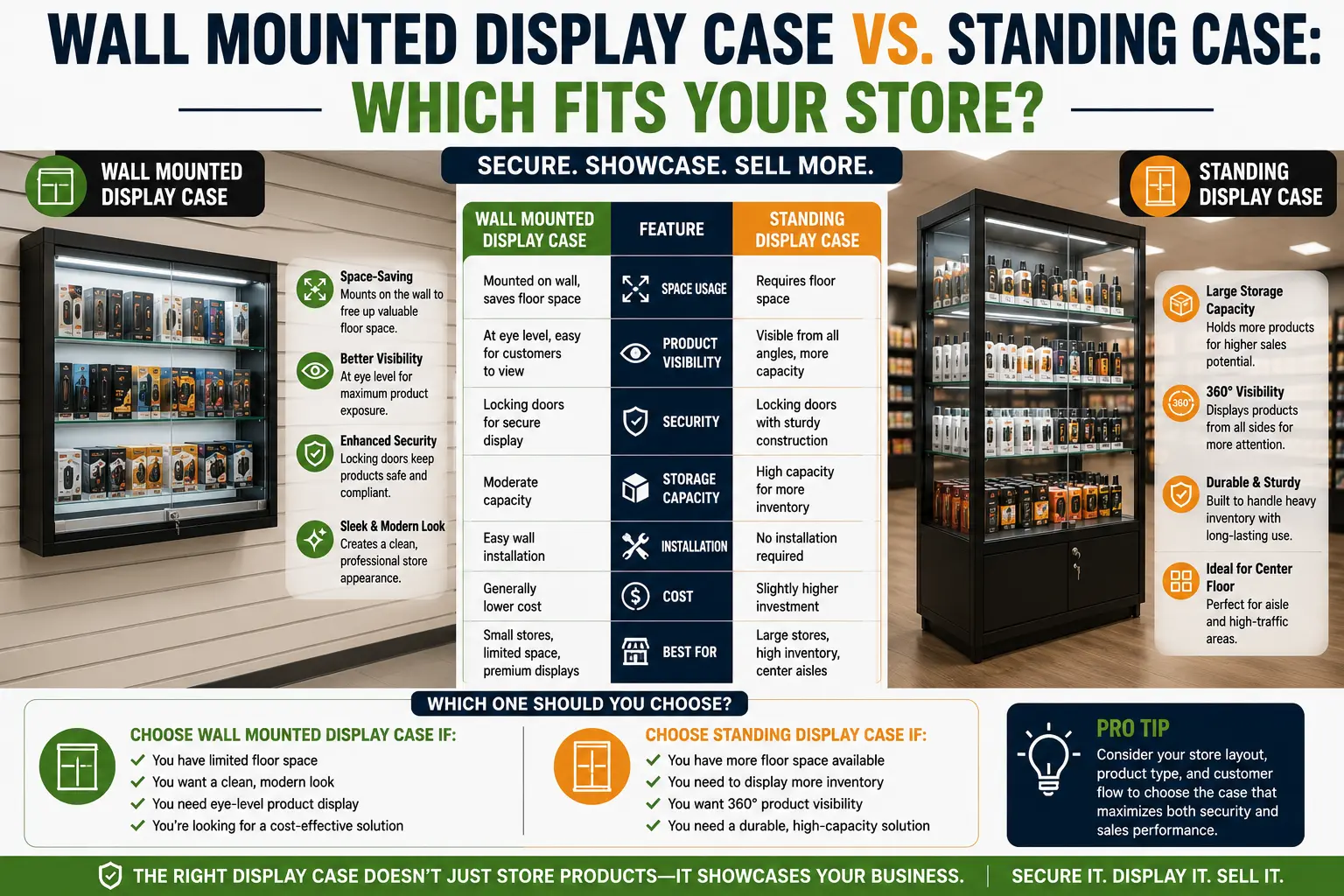
Before you order a showcase, it helps to decide between two very different layouts: a wall mounted display case that hangs against the wall, or a freestanding case that stands on its own in the middle or corner of your floor. Both protect and present merchandise behind glass, but they use your store’s space in very different ways, and picking the wrong one can cost you either aisle width or sightlines. Here is how the two compare.
The Core Difference
A wall mounted display case attaches to or sits flush against a wall, using vertical space that would otherwise go unused. A standing case, sometimes called a tower case or freestanding showcase, has finished sides and stands independently, which lets customers view it from more than one angle. The choice usually comes down to how much open floor space you have and how you want customers to move through the store.
Wall Mounted Display Cases
Because a wall mounted display case sits against the wall, it takes up zero extra aisle width beyond its depth, which is typically 14 to 20 inches. This makes it the better choice for narrow stores, tight counter areas, and any layout where every inch of walking space matters. Options range from a full vision wallcase with glass on every surface to a slim frame glass wall display case built for spots where depth is limited.
- Uses minimal floor footprint since it mounts against the wall
- Viewed from one side only, which suits behind-counter placement
- Easier to secure since staff control access from a single side
- Available in 4 ft and 6 ft widths, plus custom sizes
Standing Display Cases
A standing case works as its own island, viewable from multiple sides, which makes it a strong choice for a store entrance, a center-floor feature display, or a corner that would otherwise sit empty. Kwality Fixtures builds several standing formats, including the Extra Vision Tower Case and corner-specific units like the Full Vision Frameless Pentagon Corner Case, which is shaped to fill an awkward corner that a rectangular case cannot use efficiently.
- Viewable from two, three, or four sides depending on placement
- Works well as a center-floor or entrance feature display
- Corner-shaped models turn dead corners into usable display space
- Needs restocking access planned from the back or a locking rear panel
Side-by-Side Comparison
| Factor | Wall Mounted Case | Standing Case |
| Floor footprint | None beyond case depth | Full case footprint, walkable on all sides |
| Viewing angles | Single front-facing view | Multiple angles, 180-360 degrees |
| Best placement | Behind counter, along a wall | Entrance, center floor, corners |
| Restocking access | From the front only | Front or rear, depending on model |
| Typical use case | Tobacco, vape, jewelry behind register | Feature displays, high-traffic corners |
Which One Fits Your Store
If your store is narrow or your counter area is already tight, a wall mounted display case, such as a premium black wall display case, is almost always the better call, since it adds secure display space without shrinking your aisle. If you have an open corner, an entrance area, or a center-floor spot that needs a focal point, a standing case makes better use of that open footprint and gives customers a reason to walk around it.
Many stores end up using both: a wall mounted case behind the register for daily-access items, and a standing case near the entrance for seasonal or promotional merchandise. Browse the complete range of wall display cases to compare styles side by side.
Frequently Asked Questions
Is a wall mounted display case cheaper than a standing case?
Wall mounted cases generally cost less than standing cases of similar length, since they use fewer finished glass surfaces and do not need a fully finished back or sides.
Can a wall mounted display case be moved later?
Most wall mounted cases can be relocated to a different wall, though it is worth planning your final layout first since moving glass fixtures repeatedly adds wear.
Do standing display cases need to be against a wall?
No. Standing cases are built with finished sides so they can be placed away from any wall, including center-floor and corner locations.
Which case type is better for a small convenience store?
A wall mounted display case is usually the better fit for small stores, since it protects the walking aisle while still adding secure, lockable display space.
Can I restock a wall mounted display case from the back?
Most wall mounted cases are restocked from the front, since the back sits flush against the wall. Standing cases can offer rear access depending on the model.
Conclusion
A wall mounted display case protects floor space and works best behind a counter or along a narrow wall, while a standing case earns its footprint by drawing customers in from multiple angles. Match the format to your floor plan first, then choose the finish and lighting that fits your merchandise and your existing fixtures.
Ready to compare options in person? Request a quote for a wall display case sized for your store, or ask about a standing configuration for your entrance or corner.