
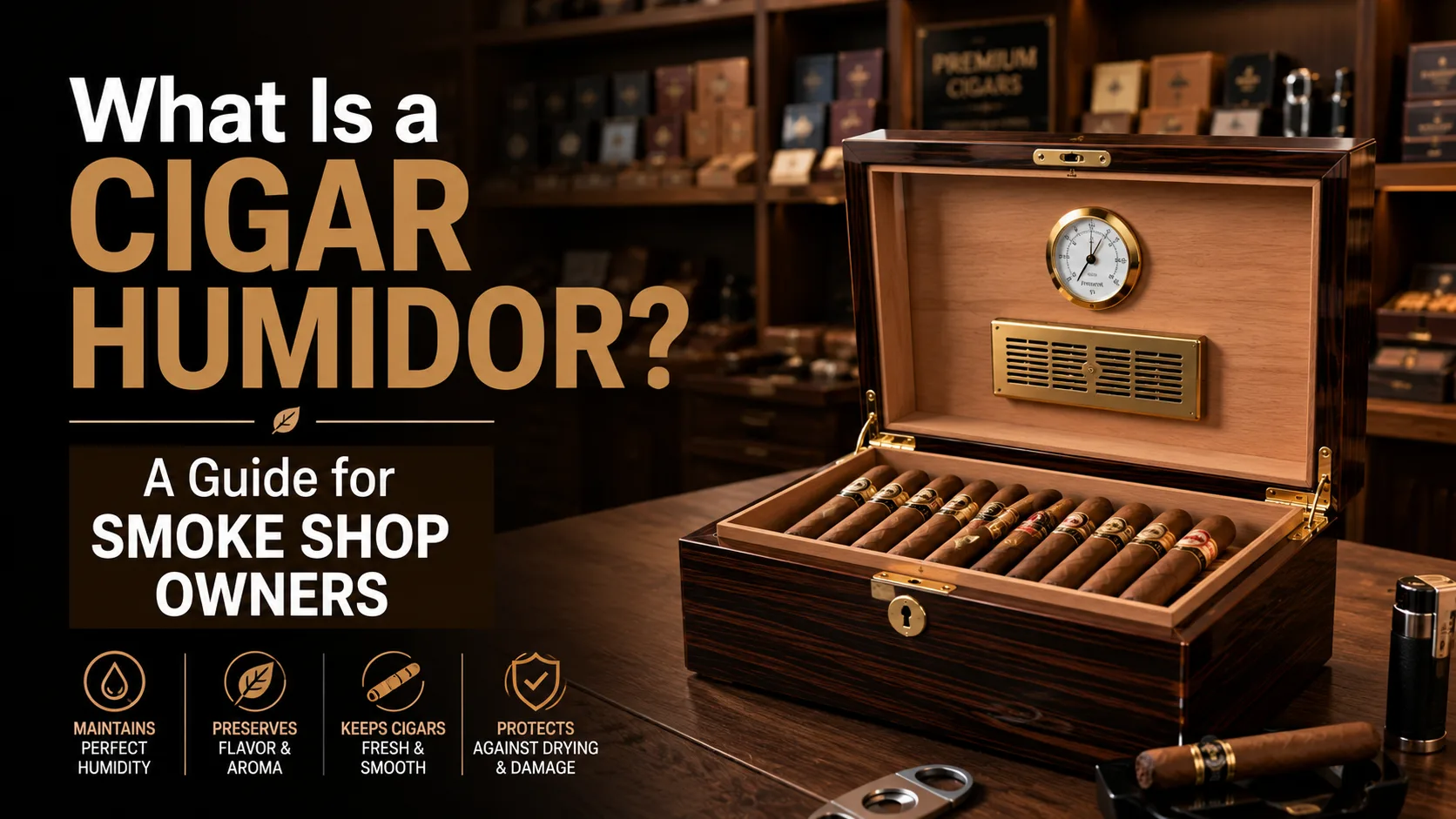
What is a cigar humidor, and why does nearly every serious tobacconist keep one on the sales floor? At its simplest, a cigar humidor is a sealed, wood-lined cabinet built to hold cigars at a stable relative humidity and temperature so they age properly instead of drying out or going soft. For a smoke shop owner, that stability is not a nice-to-have. Cigars that crack from dryness or grow mold from excess moisture become unsellable inventory, and customers notice the difference between a properly humidified stick and one sitting in dry retail air. This guide covers what a cigar humidor does, how it differs from an ordinary display case, and what to look for before you outfit your store. Browse the full cigar humidor collection from Kwality Fixtures as you read.
What Is a Cigar Humidor and Why Retailers Need One
A cigar humidor is more than a wooden box. It is a controlled microenvironment. Cigars are rolled from tobacco leaf that needs to stay between roughly 65 and 72 percent relative humidity to burn evenly, hold its oils, and deliver the flavor the blender intended. Drop below that range and wrappers crack, and cigars burn hot and canoe unevenly. Climb too far above it and cigars turn spongy, lose flavor, and risk mold or tobacco beetle activity. A retail humidor solves this with an airtight cabinet, a humidification source, and a hygrometer, working together so the shop does not have to babysit every box on the shelf.
For a smoke shop, the humidor is not just storage, it is also merchandising. A well-built humidor displays inventory while protecting it, letting customers browse cigars by brand or ring gauge without disturbing the internal climate. Retailers who skip this and store cigars in an ordinary glass case are gambling with product quality, and repeat customers notice when the smoke is not right.
How a Cigar Humidor Differs From a Standard Display Case
Plenty of shops use a glass display case to show off premium cigars, but a display case and a cigar humidor solve different problems. A display case is built to show product behind glass. A cigar humidor is built to preserve product while showing it. The difference comes down to two things: how sealed the cabinet is, and whether it actively manages humidity.
Airtight Seal and Insulation
A standard display case is often gasketed for dust, not humidity. Room air moves in and out with every door open, and there is little insulation to slow temperature swings from HVAC vents or storefront sunlight. A cigar humidor cabinet, by contrast, uses a tighter door seal and often a cedar wood lining that buffers humidity swings and adds a faint aroma many collectors associate with proper aging. The tighter the seal, the less work the humidification system has to do.
Humidification System and Hygrometer
The second difference is active control. A display case has none. A cigar humidor includes a humidification source, ranging from a gel or crystal unit to a built-in electronic system, along with a hygrometer that gives a real-time humidity reading without opening the door. Together, these two components let a humidor hold cigars at a stable level for months instead of days. Without them, you are relying on whatever the surrounding room happens to be, and Georgia’s seasonal humidity swings make that a risky bet for inventory worth thousands of dollars.
Types of Retail Cigar Humidors
Once you understand what is a cigar humidor built to do, the next question is which format fits your store. Retail humidors generally fall into two categories, and the right one depends on floor space, budget, and how large your cigar storage needs are expected to grow.
Walk-In Humidors
Walk-in humidors are room-sized units, essentially a small sealed room lined and climate-controlled to hold humidity across hundreds or thousands of cigars at once. They suit large tobacconists and lounges where customers browse inside the room itself, and where the sheer volume of inventory makes a cabinet impractical. Building one typically means a dedicated space with proper insulation, a strong humidification system, and enough air circulation to keep humidity even from floor to ceiling. It is a bigger investment, so it tends to make sense once a shop has outgrown cabinet-style storage.
Cabinet and Countertop Humidors
For most smoke shops, especially ones just getting started or working with a smaller footprint, a cabinet-style cigar humidor covers the need without a construction project. These stand-alone units combine everything a walk-in offers, sealed storage, active humidification, and a hygrometer, in a display piece that fits against a wall or behind a counter. A cigar humidor cabinet also doubles as merchandising, letting customers see the inventory through glass doors while the interior stays protected.
Kwality Fixtures stocks cabinet-style humidors sized for exactly this use case. The Single Door Cherry Cigar Humidor is a common starting point for shops building their first serious humidor program.
| PRODUCT SPOTLIGHT Single Door Cherry Cigar Humidor A cabinet-style cigar humidor in warm cherry finish, built for smoke shops and boutique tobacconists. Key Features • Holds approximately 2,000 cigars across 7 adjustable shelves • Built-in hygrometer and LED interior lighting • Lockable door with a free humidifier included • Dimensions: 15.5″L x 24″W x 78.5″H Price: $1,299.00 Shop the Single Door Cherry Humidor » |
What Size Cigar Humidor Does Your Store Need
Sizing a cigar humidor comes down to two numbers: how many cigars you stock today, and how many you expect to stock within the next year or two. Undersizing is the most common mistake new smoke shop owners make. A humidor that fits your opening inventory with no room to spare will feel cramped within months, and shuffling stock in and out of a full cabinet stresses the seal and the humidification system.
A rough rule of thumb: count your current cigar inventory, then plan for roughly double that within a year. Shops opening with 1,000 to 1,500 cigars often outgrow a single-door cabinet inside twelve months and move up to a double-door format. If you already know your store will carry a wide catalog, it is worth looking at a larger option like the Double Door Cherry Cigar Humidor, which holds roughly double the capacity of a single-door cabinet.
Floor space matters too. Measure the wall or counter run before you order, and confirm door swing clearance.
Cigar Humidor Maintenance Basics
Buying the right humidor for cigars is half the job. Keeping it running correctly is the other half, and it does not take much time once it becomes routine.
Check the hygrometer weekly. A quick glance tells you whether the cabinet is holding steady, and catching a slow drift early prevents a whole case from drying out unnoticed.
Refill the humidification unit on schedule. Most units need attention every few weeks depending on door traffic and how dry the surrounding air is.
Use distilled water only. Tap water introduces minerals that can clog a humidification unit and, over time, damage the wood lining.
Keep the humidor out of direct sunlight and away from HVAC vents. Both cause temperature swings that fight the humidity control system.
Rotate stock. Cigars sitting in one spot for months age unevenly compared to stock moved and sold regularly.
Choosing the Right Cigar Humidor for Your Shop
So, what is a cigar humidor worth to a retail business? For most smoke shops, it is the difference between inventory that holds its value and inventory that quietly degrades on the shelf. Whether you are outfitting your first countertop cabinet or planning a walk-in, the fundamentals stay the same: an airtight seal, active humidification, and a reliable hygrometer.
Kwality Fixtures builds and stocks cabinet-style cigar humidors from our Tucker, Georgia facility. Browse the full cigar humidor collection, or read our buying guide comparing every model if you are ready to compare options side by side. Need help picking the right size for your store? Contact our team for a free quote.
FAQs
What Is a Cigar Humidor, Exactly?
To put it plainly, what is a cigar humidor comes down to this: it is a sealed cabinet or room built to hold cigars at a stable relative humidity, typically mid-60s to low-70s percent, along with a matching temperature. It combines an airtight enclosure, a humidification source, and a hygrometer so cigars age properly instead of drying out or absorbing too much moisture.
What Humidity Level Should a Retail Humidor Hold?
Most tobacconists target somewhere between 65 and 72 percent relative humidity, with 70 percent a common middle ground for retail stock. Going much lower risks dry, cracking wrappers. Going much higher invites mold and tobacco beetle activity. A working hygrometer is the only reliable way to confirm where your cabinet actually sits.
What Is the Difference Between a Personal and a Commercial Cigar Humidor?
A personal humidor is usually a small box or desktop unit built for a few dozen cigars at home. A commercial cigar humidor is built for retail volume, hundreds or thousands of cigars, with a sturdier cabinet, a stronger humidification system, and often a lockable door for merchandising.
Can a Cigar Humidor Double as a Display Case?
Yes, cabinet-style humidors are designed for exactly that. Glass doors let customers see the inventory while the sealed cabinet keeps humidity and temperature stable inside. It is one of the main reasons smoke shops choose a humidor for cigars over a standard display case.
How Long Does It Take to Season a New Humidor?
A new wood-lined humidor typically needs one to two weeks to season before it is loaded with inventory. Seasoning means wiping the interior with distilled water or a light solution so the wood absorbs moisture and stabilizes, which keeps it from pulling humidity away from your cigars once stocked. Skipping this step is a common reason new humidors struggle to hold a steady reading in the first month.